
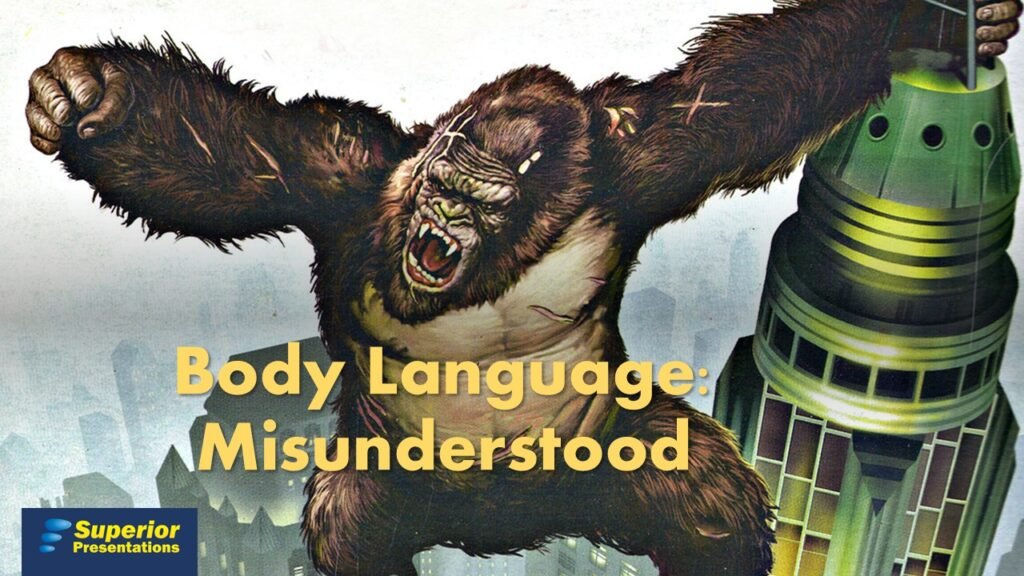
When you think of King Kong, you might picture brute strength, chest pounding, roaring rage, and destruction. The image is unforgettable, a giant ape atop the Empire State Building swatting at airplanes while clutching a young woman. The world perceived a monster out of control.
But what if that was the wrong reading?
What if Kong’s greatest tragedy was not his fall, but that nobody understood what he was trying to communicate?
Kong didn’t speak with words. He spoke through movement, posture, expression, and action. In other words, he communicates through body language. And when we examine his behaviour more closely, a different story emerges.
When Kong first encounters Ann, he does not immediately crush or kill her. Instead, he studies her. He leans in. He tilts his head. He sniffs. He watches. These are signals of curiosity, not aggression. In human communication, curiosity often appears as leaning forward, maintaining focus, and observing closely. Yet because Kong is enormous and physically intimidating, his curiosity is interpreted as threat.
How often does that happen in business?
A senior executive asks sharp questions and is perceived as hostile, when they may simply be deeply curious. A leader with a commanding presence enters a room and people become tense, even if the leader intends warmth and openness. Size, status, and physical presence can distort how body language is interpreted.
Kong also demonstrates protection.
He rescues Ann from danger multiple times. He holds her carefully, remarkably carefully for a creature of his size. He shields her from predators. He places her high above danger. In Kong’s world, proximity means protection. Keeping something close, means guarding it.
Yet humans interpret this as possession.
Again, the signal is misunderstood.
Intent and interpretation are often miles apart.
Then there is Kong’s anger: the chest beating, roaring, and explosive displays of force. Here, the message is unmistakable: Stay away. I feel threatened. In nature, larger movements, louder sounds, and expanded posture are classic warning signs. Humans display versions of this too: raised voices, aggressive gestures, rigid posture, clenched jaws. These are often defensive signals, not offensive ones.
By the time these signals appear, earlier messages have usually been ignored.
That is a lesson worth remembering.
Many people do not begin with aggression. They begin with subtle signals: withdrawal, silence, tension, shortened answers, reduced eye contact, or controlled frustration. When those signs are missed, emotion escalates.
Kong’s final climb up the Empire State Building is often framed as defiance. It may have been desperation. He was cornered, overwhelmed, attacked, and holding onto the only familiar connection he had left. Height gave him safety. Ann gave him comfort.
His body language was not saying, I want to destroy your world.
It may have been saying, I do not understand your world, and I am trying to survive it.
That is a powerful communication lesson.
Before judging a person’s behaviour, ask:
What might they actually be signaling?
Body language speaks constantly.
The real challenge is learning to read beyond appearances.
Sometimes what looks like a monster is simply a misunderstood message.