
Effective Communication As Your Competitive Advantage
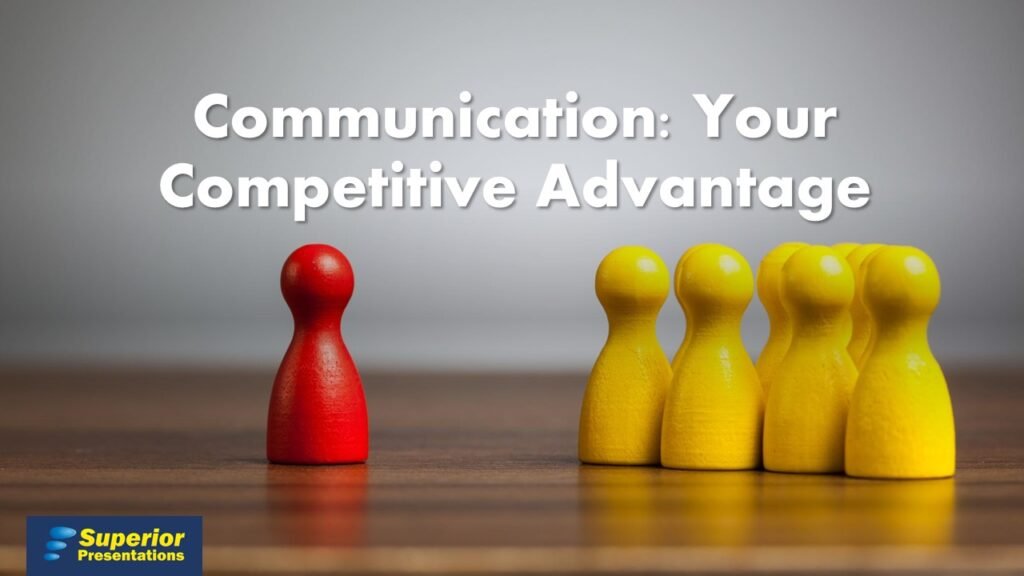
Communication as Your Competitive Advantage The Power of Effective Communication as Your Competitive Advantage Many people chase expertise. Fewer chase the skill that reveals that expertise.That skill is communication. In a noisy world crowded with credentials and claims, communication is the leverage that makes you different. It is your most accessible and most underused competitive advantage. Skill gets you in the door. Communication determines how far you advance. Albert Einstein reminded us, “If you can’t explain it simply, you don’t understand it well enough.”Your ability to explain, persuade, clarify, and connect is often the only evidence others ever see of your competence. Competence is Invisible. Communication Makes It Visible. Here’s the truth that most professionals forget:People cannot see your experience, your years of study, or your intentions. They only see your communication. That is how they judge your intelligence, your reliability, and your confidence. I coached two executives competing for a VP role. Both had strong resumes. Both delivered results. The only difference? One spoke in long, tangled sentences. The other spoke with clarity: short, strong, purposeful statements. Guess which one earned the job?The decision wasn’t based on competence; it was based on communication. George Bernard Shaw captured the trap perfectly:“The biggest problem in communication is the illusion that it has taken place.” The illusion hurts careers. It hurts businesses. And it is avoidable. Communication Drives Business Success Business rewards clarity. Teams trust leaders who articulate expectations. Clients prefer suppliers who explain value. Investors choose founders who communicate vision. When communication improves, everything speeds up: Decisions are made faster because expectations are clear. Collaboration strengthens because people understand the goal. Sales increase because the value proposition makes sense. Reputation rises because your message spreads with consistency. Communication doesn’t just share information.Communication transfers confidence.When you speak clearly, people feel safer trusting you. The Strategic Edge Most People Overlook Communication multiplies your skill set. Whatever talent you already have, leadership, strategy, analytics, creativity – communication amplifies it. Think of communication as a force multiplier: It attracts opportunities. It strengthens relationships. It differentiates you when everyone looks similar on paper. It increases influence even before you gain authority. A quiet professional becomes a visible leader when they learn to describe their ideas with clarity and conviction. A messy communicator no matter how brilliant often gets overlooked. The Five Elements That Create Competitive Advantage Clarity People follow clarity. A clear voice sounds like a confident mind.Clarity reduces friction, confusion, rework, and doubt. Brevity If you can’t summarize your point in one sentence, you don’t own it yet.Brevity doesn’t mean short, it means essential. Storytelling Data informs. Stories persuade.A short, relevant story turns logic into meaning. One manager told me, “The quarter was tough.” Another said, “Imagine pushing a stalled car uphill in the rain, that was Q2.”Who do you remember? Curiosity Powerful communication starts with powerful questions.Great communicators listen more than they speak and therefore speak with more precision. Presence Your voice, posture, and facial expression broadcast confidence long before your words do. We filter your words through what we see and feel about you and your delivery. People equate calm delivery with competence, even if the content is identical. The Cost of Weak Communication Weak communication destroys opportunity: Missed promotions Lost clients Damaged trust Avoidable mistakes Repeated confusion Teams who disengage because they don’t understand the direction Lee Iacocca said it bluntly:“You can have brilliant ideas, but if you can’t get them across, your ideas won’t get you anywhere.” You don’t lose opportunities because you are incapable.You lose opportunities because people don’t see your capability. Communication in Action: Everyday Examples Consider these typical situations where competitive advantage appears: The engineer Once invisible in meetings, now explains concepts in human language.Suddenly invited to speak to clients. Influence rises. The project manager Starts setting expectations clearly.Rework decreases. Teams breathe easier. Schedules are met. Leadership notices. The sales professional Asks better questions. Listens with intention.Closes more deals, not because of tricks, but because of clarity. The entrepreneur Refines their message into a simple value statement.Prospects finally understand what problem they solve. Business prospers. In each case, the skill didn’t change.The communication changed.And that changed the outcome. Your Communication Is Your Brand Every conversation is a branding moment.Every email is a sample of your thinking.Every presentation is a chance to distinguish yourself. Your message shapes your reputation.Your delivery shapes your future. This is why I coach clients to eliminate filler words, use strong verbs, simplify sentences, and focus on what the listener needs to know next. The purpose of communication is not to display intelligence.The purpose of communication is to change what happens next. The Call to Action: Sharpen the Skill That Sharpens Every Other You already have expertise.Now amplify it with better communication. Learn to speak clearly. Learn to explain simply. Learn to tell stories that reveal meaning. Learn to pause. Learn to ask better questions. Learn to make your message easy to hear, easy to remember, and easy to act on. Do that, and you gain the advantage most professionals never even notice, until they see others rise faster. Your voice is your competitive advantage. Sharpen your voice. Watch your competitive advantage grow. Ready to boost your competitive advantage? Improve your communication skills! Access More Presentation Skills Resources Looking For A Speech Coach? Learn More Here
Why Does Communication Fail?
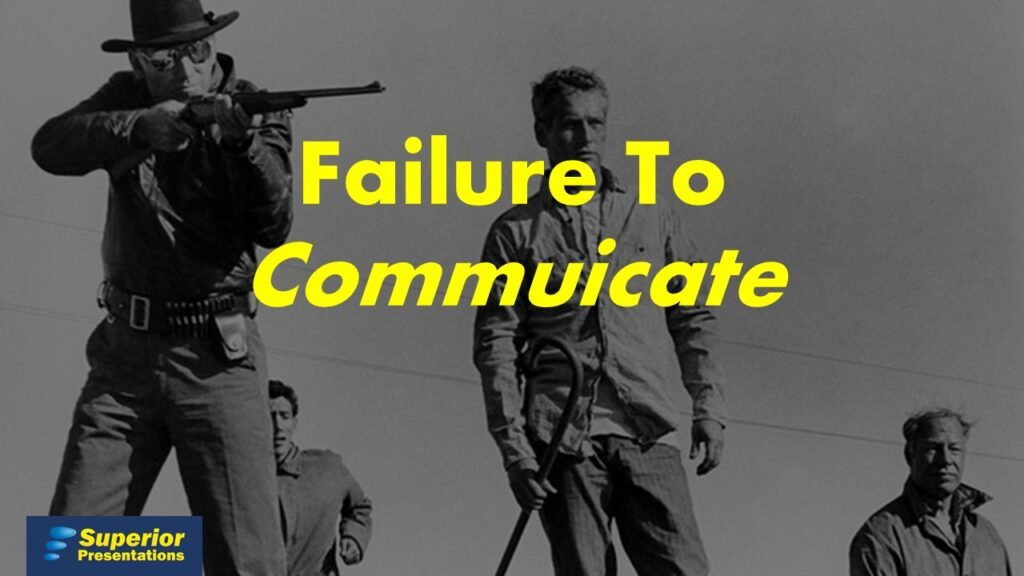
Why Does Communication Fail? When did you last experience a failed communication? Perhaps it was with your spouse, child or other family member. Was it with a team member at work, a client or supplier? What were the points of communication breakdown? What were the results of those failures to communicate? How did you resolve the problem? Are you still wondering how to fix it? Sometimes the intended message doesn’t get through. Sometimes the communication breaks down, and they don’t receive the message you intended. Maybe they heard a different interpretation of your intended message. Was it the words you used or another factor? Maybe they heard the real message that your words masked but your emotions revealed. Let’s explore a graphic illustration of failed communication in the classic movie, Cool Hand Luke. “What we have here is a failure to communicate.” That statement is from the movie, Cool Hand Luke, staring Paul Newman as Cool Hand Luke, a rebellious inmate in a southern USA chain gang prison during the early 1950s. You might not relate to life in a chain gang prison, yet you might still relate to the communication challenges in this movie. That statement appeared at two significant events during the movie. The first time is when the captain of the prison camp proudly presented Luke as the recaptured prize after Luke’s first attempted escape. As the captain of the prison camp, the only message he wanted the prisoners to receive was “don’t mess with me”. Yet, he didn’t say that. Instead, it seems he craved respect and appreciation from the prisoners that he threatened and dominated. After Luke was captured and presented to the rest of the prison gang, additional shackles were attached to his feet. The captain announced that the shackles were for Luke’s own good. Or were the shackles punishment? The Danger of Emotion Luke defiantly responded with sarcasm, “I wish you would stop being so good to me, Captain.” Luke would have been more productive if he said, “Please take these shackles off me because I’ve learned my lesson.” Too late. At that point, the angry captain responded with, “Don’t you ever talk to me that way”, then he beat Luke viciously with his whip. After Luke is lying on the ground, the captain speaks to the group and utters the phrase, “What we have hear is a failure to communicate.” Why did he say that? Curious that he didn’t admit that he failed to communicate. Instead, he suggested that the failure to communicate fell upon the receiver. In other words, “It’s your problem that you didn’t understand my message, not me. How many times have we stated our message and blamed the receiver for misunderstanding? There were many failures to communicate in this movie, and I believe that was the point. The movie followed Luke on his journey as a rebel. It was easy to admire him as the rebel and then you need to sit back and ask. “Luke, what’s your point?” What are you trying to accomplish? Why are you being so self-destructive? What’s your purpose and your intended message? I believe that Luke didn’t figure that out for himself and that might be the lesson for us. What’s your point? What do you want to accomplish? What’s your intended message? What we have here is a failure to communicate. In the final scene, Luke escaped prison again and is surrounded by the prison authorities led by the captain. Luke in his bold and continued rebellious way appears at the window in his refuge and mocks the captain by repeating the captain’s phrase, “What we have here is a failure to communicate.” That might seem like a poignant summary of this movie until the captain grabs a rifle and puts a bullet in Luke’s head. That was a sad and shocking end to this movie because I was rooting for Luke the rebel. Perhaps it was meant to reinforce the failure to communicate. Perhaps the movie was a reinforcement of the difference between what people meant to say with their emotions and what they said with their words and then with their actions. Early in the movie when Luke boosted, “I can eat 50 eggs” what was he really trying to say? Maybe he was trying to say, “I’m different”, “I want your respect”, “I will break your rules”. When the captain announced, “What we have here is a failure to communicate”, was he admitting his own failure to communicate or was he suggesting that it’s your problem that you didn’t understand my message? That’s an easy mindset in a prison. I wonder how many executives and managers think the same way. You’re my prisoners. It’s your job to understand, not my job to understand. When Luke repeated that phrase at the end of the movie, he was right. You are not communicating with me and I’m not communicating with you. That was his dying statement because the bullet in his head delivered the final message from the captain. I imagine that you will experience many failures to communicate in your workplace. How will you recognize them? How might you resolve them? In this movie communication failed because of emotions. Effective communication starts with you understanding your audience and how they might be receiving your message. Avoid the failure to communicate when you understand and deliver your intended message. Access More Presentation Skills Resources Looking For A Speech Coach? Learn More Here
Why Are Communication Skills Important?

Why are Communication Skills Important? Perhaps you agree that communication skills are important. Many people will agree with you. But ask them to explain “why?” and they might stumble while searching for a clear explanation. I’ve been studying and teaching communication skills for three decades, so I’ve had the opportunity to ponder this question. And no, I’m not a perfect communicator. I don’t believe such a person exists. It’s a matter of making mistakes, learning and improving. “Communication skills are important” What does that mean? I believe that “effective communication skills” are critical to your success in life and career. Poor communication skills will cost you opportunities, relationships and happiness. Communication is two-way. It’s about sending and receiving messages. Understand what others are saying to you and convey your message clearly to them. The primary goal is for your communication skills to be better than your competition, whoever and whatever that is. That might be another speaker presenting an opposing idea. It’s likely the doubts and distractions within the minds of your audience. Communication Skills are Important to Career Success When you are looking for a new job, you start by understanding their need and checking for your match to their expectations. You write and adapt your resume to align with their needs, then you personalize your cover letter to reinforce the match to catch their attention and communicate your value. That’s followed by more critical communication in the form of email, phone calls, Zoom calls and in-person meetings. There’s lots of pressure on you to perform admirably to impress them enough to offer you the job. There might be some negotiation involved before you agree to work together. Negotiation is a specialized form of communication that you also need to learn. Success! You got the job and you enjoy the work environment. You want to stay and grow. The next challenge is the daily communication within the workplace. You meet and talk with your workmates. You attend and participate in meetings and discussions. You communicate with clients and suppliers. You contribute to project teams which requires intense communication. You build confidence to present your ideas to the team and leadership. You learn by observing, questioning and listening. At some point you train new team members. You demonstrate your leadership potential through your communication skills. Your communication skills get you the job, help you thrive and create new opportunities for you. Communication Skills are Important to Organization Success Having the superior product or service is never enough to guarantee mission success. Apple is acknowledged as offering leading edge technology and Steve Jobs is often modeled as a superior communicator – both in the office and on the public stage. If you are not the Apple of your industry just imagine how much better your messaging needs to be. Organization leaders are often expected to present their message with confidence and clarity to staff, clients, partners, investors and the public. Millions of dollars can ride on these presentations. Communication Skills are Important to Stress Reduction The financial cost of stress to organizations is staggering. Work related stress can be demoralizing to staff, management and executives. Effective communication skills reduce miscommunication, which is likely the biggest cause of work-related stress. Have you ever heard negative feedback about your messaging only to say or think, “but that’s not what I meant”? The damage is done. They misinterpreted your message. Maybe you could have communicated differently for better results. In the workplace there are many channels for communication and all of them are open to miscommunication. Imagine if everyone in your workplace improved their understanding of communication and enhanced their skills. Less stress and stronger productivity. Communication Skills are Important to Time Management Most presentations and meetings take too much time because people are unable to communicate effectively and efficiently. Say less to get the message across. Speak to the issue and interest of the audience. What if you say it in five or ten minutes instead of 30 or 45 minutes? Meetings get off topic and people ramble about unrelated issues. People say what they believe they need to say instead of what needs to be said and done. Emails bounce back and forth that simply wastes everyone’s time and aggravates them. Stop wasting time with sloppy communication. Communication Skills are Important to Leadership Leaders are expected to communicate effectively because people need to hear their message. Leadership in your community, association or business demands effective communication skills. Every cause needs a leader. Every leader needs to be able to speak to deliver a clear and inspiring message. They need to speak one-on-one, one to few and one to many. The team and followers will often judge the leader and the cause on the communication skills of that spokesperson. Who respects and follows a leader that can’t communicate? Communication skills are Important to Public Image & Opinion It might seem unfair, but we will often judge you, your organization and your value on how you, your staff or executives communicate. We will tend to remember the extremes – extremely bad or especially good. Compared to what we’ve experienced, you are good, putrid or simply ho-hum. Remember that our perception is relative to what we’ve seen from other communications. Better communication doesn’t guarantee success. Instead, it gives you a better fighting chance of success. Almost everything you want to accomplish is a fight. Why not gain a powerful edge in your favor? Improve communication skills for you and your team. For these reasons you can see clearly why communication skills are important to you and your success. Get ready to out-communicate your competition. Access More Presentation Skills Resources Looking For A Speech Coach? Learn More Here
How to open your presentation

How To Open Your Presentation How to open your presentation Your first words are important because your audience is judging you. They are scrolling through questions in their mind: Should I listen? How long will this take? Do I trust the person? How painful will this be? When will we get to the relevant part? What does this mean to me? The purpose of your opening is to grab their attention, establish rapport and set the direction. Most importantly – grab attention. How might you do that? First, be aware of silly phrases to avoid: My name is… and a little bit about me (we don’t care) Today I’m going to talk about (boring) Thank you for inviting me to speak (boring and irrelevant) I’m honored to be invited (wasting time and feeling phony) Instead, start with: An enticing promise A bold statement An intriguing question An emotional trigger Study these suggested phrases for each opening method. An enticing promise: By the end of this presentation, you will understand the 3 criteria for You have the tools for success, and today you will learn how to use them You don’t need to waste more money if you use this process A bold statement: If we don’t address this threat, we will be out of business in six months Success is never easy, yet it can be simple We have a secret weapon that is waiting to be used An intriguing question: Did you know… Would it surprise you to learn… What is the most dangerous question that our clients are asking about… An emotional trigger: Imagine a world where… (The word “imagine” engages and triggers our imagination) How would you feel about… (“feel” is emotional and more powerful than “think” which is logical) What scares you about… (tap into the powerful emotion of fear) My daughter asked me about… (family stimulates emotional connections) Review these opening phrases. Rehearse them out loud. Play with different endings that fit your circumstances. Get comfortable with these opening lines. Imagine the power of your presentation when you grab their attention with your first words. Access More Presentation Skills Resources Looking For A Speech Coach? Learn More Here
Speak to an Audience of One

Speak To An Audience of One Imagine how you might feel when you’re sitting in an audience listening to a speaker and it feels like the speaker is talking directly to you. It seems more like a one-to-one conversation despite the audience present. Now imagine that you could convey that intimate feeling when you are the speaker. The secret is to speak as if you’re speaking to one person. Sounds simple yet few speakers have mastered this technique. Here are three changes to make in your presentations to connect with your audience as individuals. See them as Individuals The first step is to adjust your mindset. Don’t see a crowd or audience. Instead, see a gathering of individuals. Imagine yourself speaking to each individual one person at a time. You can get into this mindset if you great them as individuals when they arrive. You don’t need to call out every name or where they are from. Simply connect with a few. The other benefit of seeing them as individuals is that you will feel less anxious about public speaking. Mind your Words Stop using crowd language. Don’t refer to them as a crowd. “Hello everybody” is both impersonal and reinforces that they are part of a crowd. Instead say “Hello”. And don’t ask “How is everybody today?” because we know you don’t care. You’re not going to let every person tell you how they are. This question is from the Motivational Speaker 101 fake enthusiasm guide. The word” anybody” is equally distasteful, as in “anybody have any questions?” Yuk. Don’t refer to the audience as “You guys”. Instead say “You” because it is both singular and plural. Make a point to use the word “you” often during your presentation because every time you say the word, each person feels as if you are speaking directly to them. Remove plural versions of words that describe the audience. Instead of saying “as members of” say “as a member of”. Use these phrases: You and your team You and your fellow members Test your words by asking yourself, “Would this be appropriate I was sitting across the table and talking to one person?” Eye Contact When you are in the room with an audience, move your glance from one person to another and hold their eyes for a few seconds before moving to the next person. By the end of the presentation every person should feel that at some point “the speaker was talking directly to me”. Of course, if you’re speaking virtually, you stare at the glass eye of the camera to convey the same feeling. Look at the camera, not the screen. Effective eye contact is from the perspective of the audience not you. It’s not that you thought you looked at them. Did they believe you looked at them? Convey the feeling that you are speaking to one person. Imagine how each person will feel when you speak to them as individuals, not a crowd. Access More Presentation Skills Resources Looking For A Speech Coach? Learn More Here