
Presentation Skills Training for Executives

Presentation Skills Training for Executives When you are ambitious and producing results, you’ll get noticed, qualify for growth opportunities and be promoted. You’re happy to be promoted and you realize that you’re not 100% ready – if you’re honest with yourself. That’s okay. You might struggle with the imposter syndrome and that’s normal. That could be a good sign because you recognise that you need to get better. And that’s another good sign because you’ll look for and embrace opportunities to improve your skills. There are many skills that you as a promising executive need to improve. The most important might be communication and presentation skills because that is how you lead your team. They will notice how you communicate with them and others. The result might be respect, cooperation and positive results. Or they might be mocking you behind your back. How to Improve Your Executive Communication Skills? What can you do to quickly improve your presentation and communication skills? You could search for books to read. You might troll YouTube for instruction videos and when you really want to improve, you’ll find a course that offers presentation skills training for executives. You’re not a university student. You’re not a first line manager. You are an executive that needs to exhibit executive presence and superior presentation skills. When you speak, you want people to listen understand and act on your message. You Won’t Learn Presentations Skills on the Job You can’t wing it. You can’t afford to waste time and opportunities while you stumble through your learning curve. Recognize your need and goal. Then get the best help to transform your presentation and communication skills. You want instruction and practical advice from an experienced executive coach and confidant. Why consider me, George Torok for this critical role? Among my three decades of coaching and training experience I instructed the Effective Executive Speaking training program for the Canadian Management Centre over 12 years with two esteemed colleagues. The program combined training with group coaching. We successfully instructed hundreds of executives from both private and public sector to transform their presentation skills. My colleagues included two astute communicators starting with Peter Urs Bender, author of the bestselling, Secrets of Power Presentations. Peter was Swiss born who came to Canada at age 18 to learn English. He loved the country and stayed. He never spoke perfect English, retained his Swiss accent, yet he became known in the press as Canada’s Presentation Guru. My other colleague was John Robert Colombo a Canadian literary icon. He has published over 200 titles or literary works as an author and editor. He received the Order of Canada for his literary success. He recognizes the power of words and oral communication. As you can imagine, I learned much from working with these two thought and action leaders. They did more than think, they acted and demonstrated their communication lessons. Although we agreed on the principles and techniques, we each had our own personal strengths and styles. That helped the executives in the classes recognize that they could leverage their individual strengths and personalities. We three instructors observed and learned from each other along with offering feedback and constructive feedback. Every class we were teaching and learning. —– What did Peter Urs Bender say about George Torok I was very impressed with your style of presenting. You have command, yet still show warmth for your audience. George you were outstanding! Peter Urs Bender, Canada’s Business Presentation Guru and author of Secrets of Power Presentations What did John Robert Colombo say about George Torok? I have known George Torok for close to a decade. The two of us work side-by-side to deliver courses at the American Management Association’s Canadian Management Centre in Toronto. After a session with George, I find I have picked up at least one new fact (or novel approach) to a problem (or a possibility) in spoken (or written) communication. So I value our association over and above our work as a team. One of George’s special talents is his ability to bring out the best in other people. He is able to put his finger on the key passage of a speech or a report and right away find a better way to express it in words, tones, or gestures. He regularly works on a one-to-one basis with senior business managers and corporate executives to assist them in the drafting and the delivery of their messages in the most effective ways possible. What surprises me the most about George is his ability “to turn a negative into a positive.” Because of his background in business and marketing, and because of his experience as a course leader and an executive coach, he shows genius in taking an ordinary, neutral, or negative statement and immediately transforming it into a message of hope, power, or achievement. John Robert Colombo, C.M., D.Litt. President, Colombo & Company; author of “Colombo’s Canadian Quotations,” editor of “Canadian Global Almanac,” and other popular reference books www.colombo.ca Who were the corporations that entrusted George, Peter and John with training their executives? See the list of those clients here: Client Results and Testimonials | Superior Presentations Access More Presentation Skills Resources Looking For A Speech Coach? Learn More Here
Why Does Communication Fail?
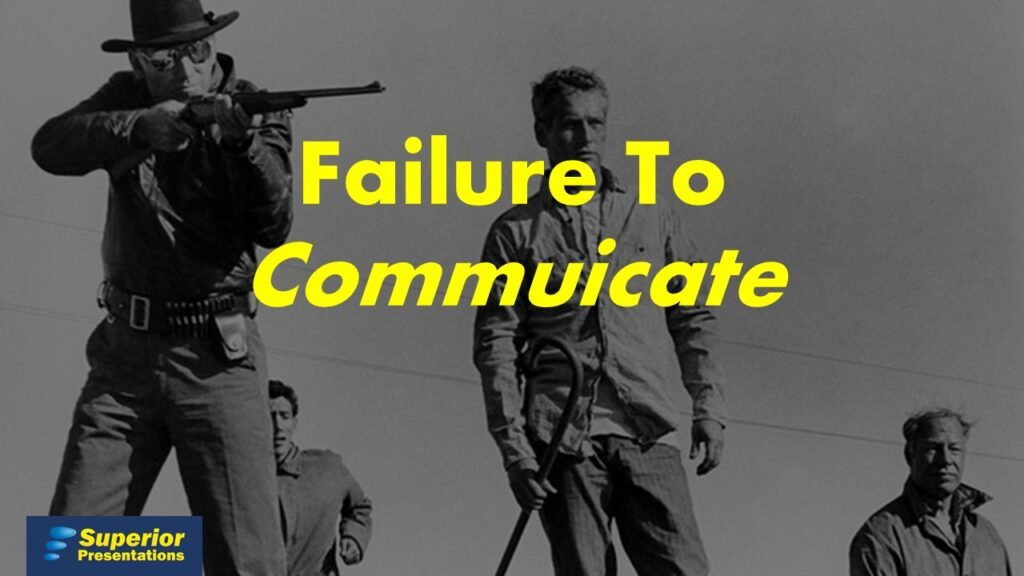
Why Does Communication Fail? When did you last experience a failed communication? Perhaps it was with your spouse, child or other family member. Was it with a team member at work, a client or supplier? What were the points of communication breakdown? What were the results of those failures to communicate? How did you resolve the problem? Are you still wondering how to fix it? Sometimes the intended message doesn’t get through. Sometimes the communication breaks down, and they don’t receive the message you intended. Maybe they heard a different interpretation of your intended message. Was it the words you used or another factor? Maybe they heard the real message that your words masked but your emotions revealed. Let’s explore a graphic illustration of failed communication in the classic movie, Cool Hand Luke. “What we have here is a failure to communicate.” That statement is from the movie, Cool Hand Luke, staring Paul Newman as Cool Hand Luke, a rebellious inmate in a southern USA chain gang prison during the early 1950s. You might not relate to life in a chain gang prison, yet you might still relate to the communication challenges in this movie. That statement appeared at two significant events during the movie. The first time is when the captain of the prison camp proudly presented Luke as the recaptured prize after Luke’s first attempted escape. As the captain of the prison camp, the only message he wanted the prisoners to receive was “don’t mess with me”. Yet, he didn’t say that. Instead, it seems he craved respect and appreciation from the prisoners that he threatened and dominated. After Luke was captured and presented to the rest of the prison gang, additional shackles were attached to his feet. The captain announced that the shackles were for Luke’s own good. Or were the shackles punishment? The Danger of Emotion Luke defiantly responded with sarcasm, “I wish you would stop being so good to me, Captain.” Luke would have been more productive if he said, “Please take these shackles off me because I’ve learned my lesson.” Too late. At that point, the angry captain responded with, “Don’t you ever talk to me that way”, then he beat Luke viciously with his whip. After Luke is lying on the ground, the captain speaks to the group and utters the phrase, “What we have hear is a failure to communicate.” Why did he say that? Curious that he didn’t admit that he failed to communicate. Instead, he suggested that the failure to communicate fell upon the receiver. In other words, “It’s your problem that you didn’t understand my message, not me. How many times have we stated our message and blamed the receiver for misunderstanding? There were many failures to communicate in this movie, and I believe that was the point. The movie followed Luke on his journey as a rebel. It was easy to admire him as the rebel and then you need to sit back and ask. “Luke, what’s your point?” What are you trying to accomplish? Why are you being so self-destructive? What’s your purpose and your intended message? I believe that Luke didn’t figure that out for himself and that might be the lesson for us. What’s your point? What do you want to accomplish? What’s your intended message? What we have here is a failure to communicate. In the final scene, Luke escaped prison again and is surrounded by the prison authorities led by the captain. Luke in his bold and continued rebellious way appears at the window in his refuge and mocks the captain by repeating the captain’s phrase, “What we have here is a failure to communicate.” That might seem like a poignant summary of this movie until the captain grabs a rifle and puts a bullet in Luke’s head. That was a sad and shocking end to this movie because I was rooting for Luke the rebel. Perhaps it was meant to reinforce the failure to communicate. Perhaps the movie was a reinforcement of the difference between what people meant to say with their emotions and what they said with their words and then with their actions. Early in the movie when Luke boosted, “I can eat 50 eggs” what was he really trying to say? Maybe he was trying to say, “I’m different”, “I want your respect”, “I will break your rules”. When the captain announced, “What we have here is a failure to communicate”, was he admitting his own failure to communicate or was he suggesting that it’s your problem that you didn’t understand my message? That’s an easy mindset in a prison. I wonder how many executives and managers think the same way. You’re my prisoners. It’s your job to understand, not my job to understand. When Luke repeated that phrase at the end of the movie, he was right. You are not communicating with me and I’m not communicating with you. That was his dying statement because the bullet in his head delivered the final message from the captain. I imagine that you will experience many failures to communicate in your workplace. How will you recognize them? How might you resolve them? In this movie communication failed because of emotions. Effective communication starts with you understanding your audience and how they might be receiving your message. Avoid the failure to communicate when you understand and deliver your intended message. Access More Presentation Skills Resources Looking For A Speech Coach? Learn More Here